
Google Maps Ranking Check: How to See Where You Really Rank
In short. A Google Maps ranking check done from your own phone is wrong by design: Google ranks on "relevance, distance, and popularity," and you are searching from the one place where distance favors you. To see where you really rank, run the same search from a grid of points around your address. Our free Google Maps rank checker does it in a minute, without signing in. What you will usually find: top 3 within a few blocks, invisible beyond. What moves a position, according to our observatory of 1,800 profiles: review volume first (738 reviews in the top 5 against 300 in positions 16 to 20, at the same 4.62 rating), then photos (110 against 54). Google adds: "There's no way to request or pay for a better local ranking on Google."
Why searching for yourself gives a false answer
Google's help page "Tips to improve your local ranking on Google" gives the three factors, and the second one is the problem:
"Relevance is how well a Business Profile matches what someone is searching for."
"Distance refers to how far each business is from the customer who's searching. If a customer doesn't share where they are, Google uses what it knows about their location."
"Prominence means how well-known a business is. [...] This factor's also based on info like how many websites link to your business and how many reviews you have. More reviews and positive ratings can help your business's local ranking."
Three consequences for your ranking check:
- Your own location is the best case. From inside your store, you are the closest business. Three blocks away, a competitor is.
- A ranking is not one number. It is a map: first here, fourth there, absent two neighborhoods away. The question is not "what is my position" but "from how much of my area am I in the top 3."
- Signed-in searches can be personalized. Do your manual checks in a private window, signed out.
Three ways to check your Google Maps ranking
| Method | How | Good for | Limits |
|---|---|---|---|
| Manual search, private window | Open Google Maps signed out, type "[category] [neighborhood or city]," note your position | A quick sanity check | One point only, and Google still guesses your location from your connection |
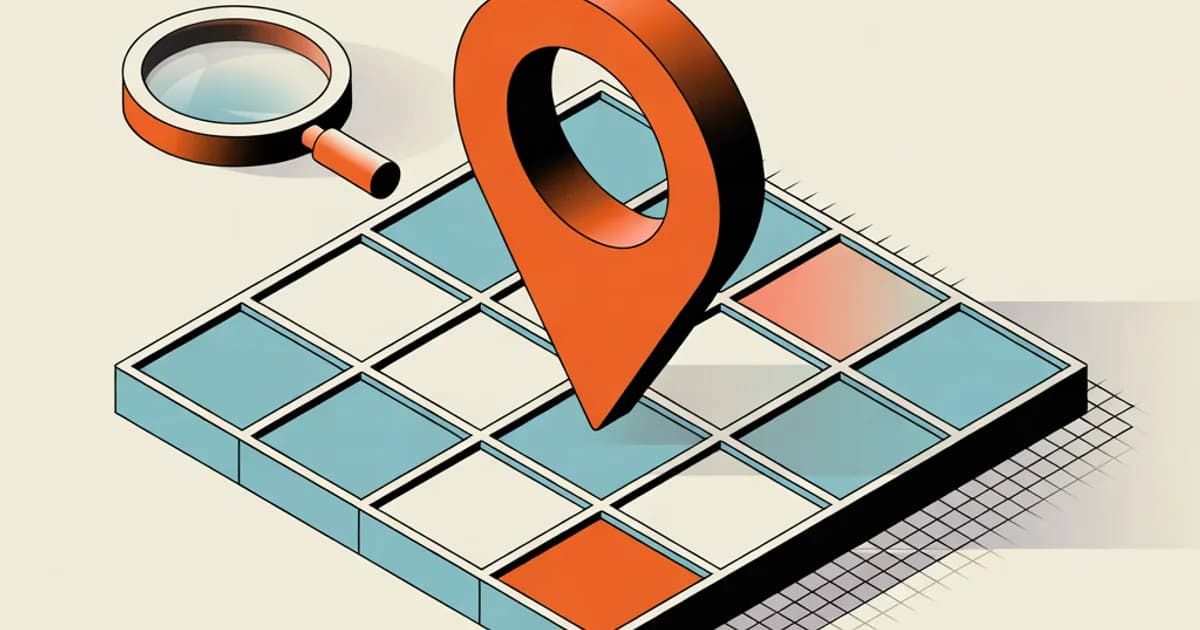
| Grid rank checker | A tool runs the search from a grid of points (for example 7 by 7) around your address and returns a position per point | Seeing the real map of your visibility | A snapshot, no history |
| Rank tracker | The grid runs every week, with history and competitor comparison | Measuring the effect of what you change | Paid, part of a platform |
For the second method, our Google Maps rank checker is free: enter your business and your main keyword, and it returns the grid. For the third, it is the local SEO tracking module of GMB Club.
How to read a rank grid
A grid gives one position per point. Read it in this order:
- Share of points in the top 3. This is your real local pack visibility. 60% means that from 6 points out of 10 where a customer could search, you are shown without a tap.
- The shape of the green zone. Centered on your address and shrinking fast means distance is doing the work and prominence is weak. Spread toward a neighborhood means something there helps: a competitor's absence, your reviews mentioning it.
- Who takes your place at the edges. Open those profiles: category, review count, photos. That is your real benchmark, not the national average.
- The same grid for two or three keywords. "Dentist" and "emergency dentist" can give very different maps for the same profile.
Then check again after each change, with the same keywords and the same grid, or you will compare two different things.
What moves a position: our data
On September 25, 2026, we collected the first 20 Google Maps results for 9 industries in 10 large French cities: 1,800 profiles. Comparing the top 5 with positions 16 to 20:
| Signal | Top 5 | Positions 16 to 20 |
|---|---|---|
| Reviews (median) | 738 | 300 |
| Rating (median) | 4.62 | 4.62 |
| Photos (median) | 110 | 54 |
The rating does not separate the two groups. Volume does, and photos follow. A keyword describing the trade in the real business name is associated with a 12-point average gain in position, up to 32 points in some industries. We found no link between reply rate and position: 46% of top-20 profiles never reply to a review.
The scale also depends on the city. For restaurants, the median review count of the top 20 is 1,538 in Paris and 337 in Lyon. The entry threshold of the top 20 (first quartile) ranges from 44 reviews for movie theaters to 388 for restaurants. The table by industry is in how many Google reviews you need.
Whitespark's 2026 Local Search Ranking Factors survey, published on November 6, 2025 from 47 experts, puts the primary category, proximity to the point of search and keywords in the business title at the top of local pack factors, and notes "an increased importance of review signals and behavioural signals" for 2026. Proximity you cannot change; the rest you can.
From the check to the fix
Once the grid shows where you are weak, the work follows Google's own list: verify the profile, complete every field, collect reviews, add photos. The method is in how to rank higher on Google Maps, and the field-by-field check in our Google Business Profile audit checklist.
For several locations, the grid becomes a dashboard: one map per location, one weekly history, one list of the locations that dropped. GMB Club is the all-in-one marketing platform for local businesses: the local SEO tracking runs the grid for every location and compares it with competitors, next to review collection and replies, social media publishing and the profile hub, from one screen. Pricing is public.
Limits of this guide
A grid is a sample: it runs the search from chosen points, at one moment, and Google's results also vary with the device, the time and the account. Our observatory covers France only, 10 large cities and 9 industries, on a snapshot dated September 25, 2026; US thresholds will differ, especially outside large cities. These are correlations, not an experiment: they do not prove that adding reviews causes a higher position. Google's quotes come from its English help page read on October 14, 2026. Whitespark's factors reflect the opinion of 47 experts, not Google data.
Guide written by Alexandre Damais, co-founder of GMB Club. Sources checked on October 14, 2026.
Frequently asked questions
How do I check my Google Maps ranking?
Not by searching from your own phone: Google ranks by distance, and you are standing in your own store. Use a rank checker that runs the search from a grid of points around your address, like our free Google Maps rank checker, or set the location manually in a private browser window.
Why is my ranking different from one street to the next?
Because distance is one of Google's three local ranking factors. Google writes that distance "refers to how far each business is from the customer who's searching." Two blocks away, a competitor can be closer than you.
Why does my ranking look different on my phone and my computer?
Each device gives Google a different location, and "if a customer doesn't share where they are, Google uses what it knows about their location." Signed-in accounts can also see personalized results.
What is a good Google Maps ranking?
The local pack shows three businesses. Being in the top 3 on your main category plus city, from most of the points where your customers are, is the target. Below the pack, the customer has to tap "More places."
Can I pay Google for a better ranking?
No. Google states: "There's no way to request or pay for a better local ranking on Google."
How often should I check?
Weekly for a single location, with alerts on drops. A rank tracker does this automatically and keeps the history, so you can see when a position moved and what changed around that date.